Punctuation with complex clauses
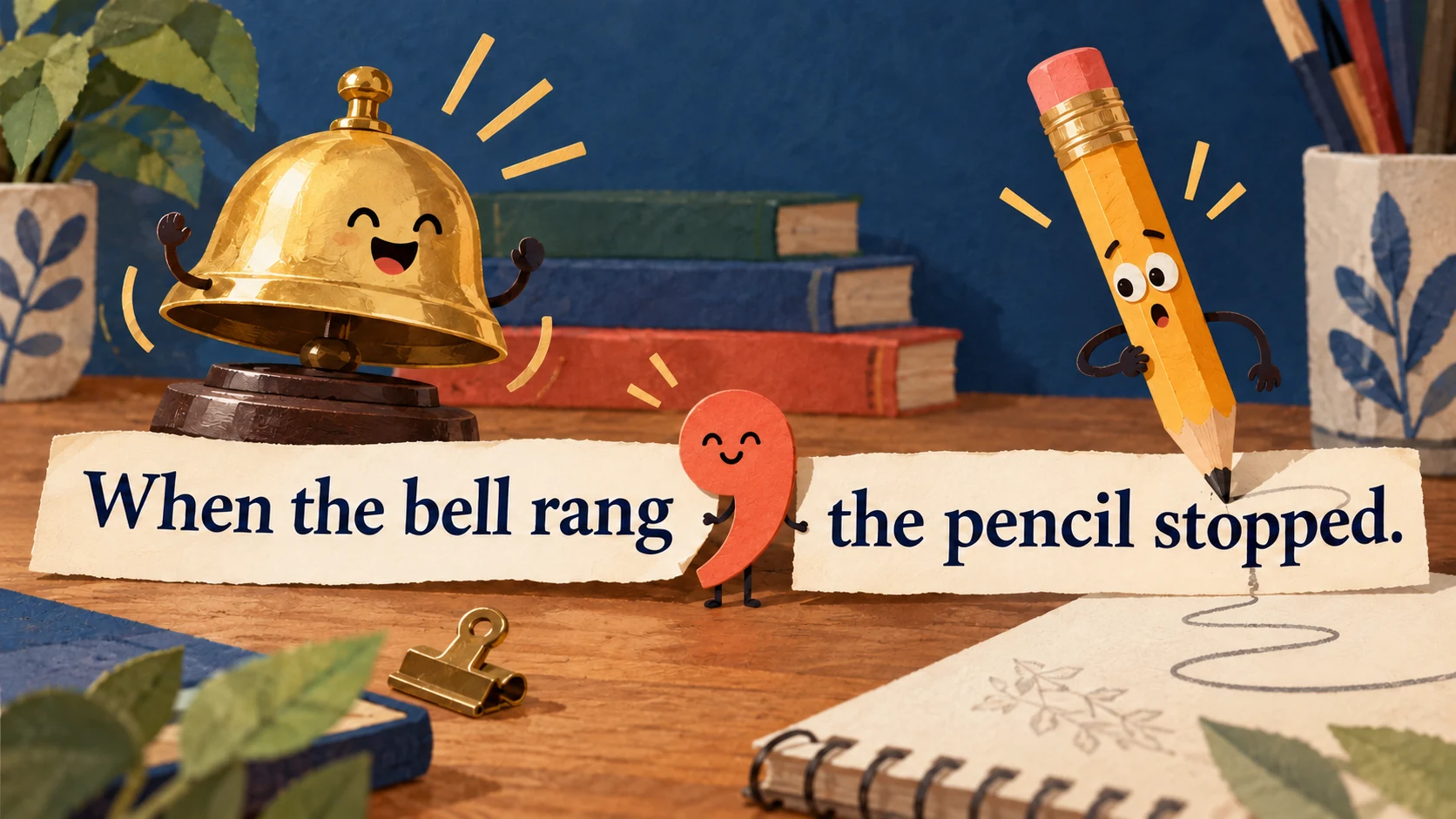
Punctuation is a reading guide. A comma can show where an introductory clause ends; a pair of commas can mark extra information; a semicolon can connect two closely related complete sentences. The first step is to find the clauses—the groups built around a subject and verb—before deciding where punctuation belongs.
Find the sentence's main structure first
Read Although the last bus had left, we managed to get home. The part we managed to get home can stand as a complete sentence. Although the last bus had left cannot stand alone with the same meaning: although makes us expect another idea. This is the difference between a main clause and a dependent clause.
| Part | Can it stand alone here? | Role |
|---|---|---|
| The last bus had left. | Yes | Main clause |
| Although the last bus had left ... | No | Dependent clause |
| We managed to get home. | Yes | Main clause |
Punctuation helps your reader see how these parts fit together. It does not depend only on where you pause while speaking: different speakers pause in different places.
Keep the subject connected to its verb
A long subject can tempt you to insert an unnecessary comma:
Incorrect:
The students who completed all the online activities, received a certificate.
Correct: The students who completed all the online activities received a certificate.
The whole phrase The students who completed all the online activities is the subject. Received is its main verb. Do not separate them with a comma just because the subject is long.
A pair of commas can enclose an interruption: The students, who had completed all the activities, received a certificate. The commas mark the beginning and end of extra information; they are not a single break between subject and verb.
Opening clauses usually need a comma
When a dependent clause comes first, separate it from the main clause:
When the meeting ended, we left.
Although the figures were incomplete, the team published a cautious estimate.
If you need more time, contact your tutor.
If the main clause comes first, a comma is often unnecessary:
We left when the meeting ended.
The team published an estimate although the figures were incomplete.
This is a useful guide, not a rule that every short opening phrase needs a comma. A comma after a long or potentially confusing opening clause makes the sentence easier to read.
Relative clauses change the meaning of commas
A defining relative clause identifies which person or thing you mean, so it normally has no commas:
The students who arrived early found seats.
This means that the students who arrived early found seats; other students may not have. A non-defining relative clause adds information about an already identified person or thing and is enclosed by commas:
The students, who arrived early, found seats.
This presents the students as a known group and adds that they arrived early. If the clause begins or ends a sentence, you still need the appropriate comma: The book, which I bought yesterday, is already missing.
Joining two complete sentences
A comma alone is not enough to join two independent clauses:
Incorrect:
The room was full, we waited outside.
Use a full stop, a semicolon, or a coordinating conjunction such as and, but, so:
The room was full. We waited outside.
The room was full; we waited outside.
The room was full, so we waited outside.
A semicolon is useful when the two ideas are closely connected and each side could stand as a sentence. It is not just a stronger comma.
Linking adverbs such as however, therefore and nevertheless do not behave like conjunctions. Separate the clauses with a full stop or semicolon:
The room was full; however, we found two seats.
Not: The room was full, however, we found two seats.
Commas in lists and around extra information
Use commas to separate items in a list: We ordered tea, bread, olives and soup. A final comma before and is optional in many styles, but it can prevent ambiguity when the last two items belong together.
An extra phrase that interrupts the main sentence usually needs a pair of commas:
Maya, who had another question, stayed behind.
If you remove the extra clause, the sentence remains complete: Maya stayed behind. Do not put only one comma around information that is non-defining: Maya, who had another question stayed behind.
Cambridge's guide to punctuation gives further examples of commas, clause boundaries and extra information.
Edit a paragraph by explaining each boundary
Here is a confusing draft:
Because the weather was bad we stayed inside, however we enjoyed the afternoon, our host who is a chef made soup.
Start by identifying three complete main ideas: we stayed inside, we enjoyed the afternoon, and our host made soup. Then give each a clear boundary:
Because the weather was bad, we stayed inside. However, we enjoyed the afternoon. Our host, who is a chef, made soup.
The first comma closes the opening reason clause. The full stops separate complete sentences. However, introduces a contrasting sentence. The two commas around who is a chef mark additional information about an identified host.
Another version is We stayed inside because the weather was bad, but we enjoyed the afternoon. Here but coordinates the main clauses, while because attaches the reason to the first one. You can choose the version that best suits the paragraph's rhythm.
A colon introduces an explanation or list
We needed three things: a map, a torch and water uses a colon after a complete introduction. Avoid separating a verb from its object: We needed: a map, a torch and water is less suitable in ordinary continuous prose.
For closely related complete statements, a semicolon can help: The forecast was poor; we packed waterproof jackets. But Although the forecast was poor; we continued is incorrect because the first part is dependent. Use a comma there.
A dependable editing habit is to find the subjects and main verbs, then ask what connects their clauses. This is more reliable than adding commas wherever a sentence feels long.
Sources and further reading
Try this structure in a short practice set with instant feedback.
Start practice