Grammar for open cloze
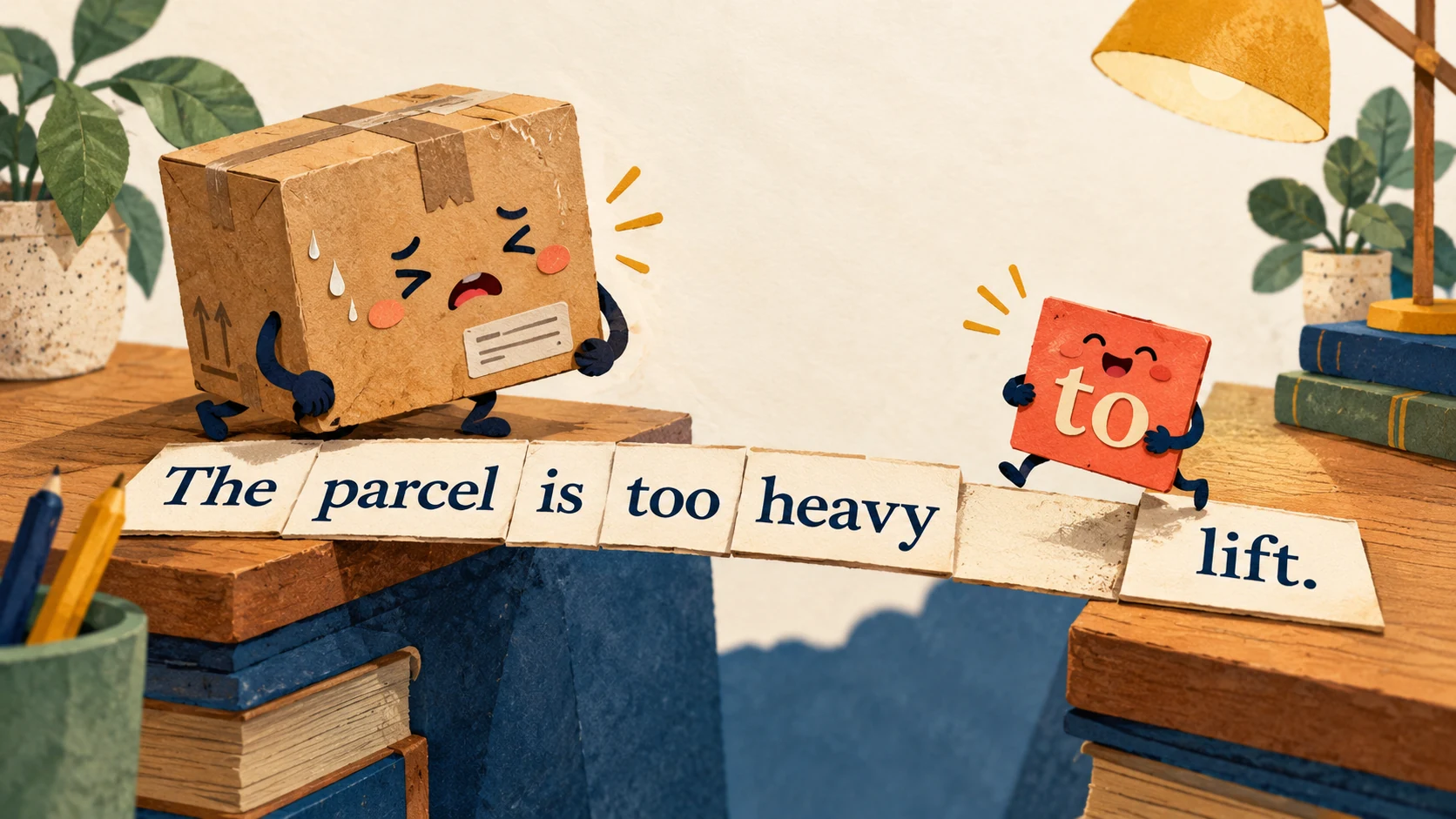
In an open cloze, each gap asks you to supply a missing word. The answer is often a small grammar word—an article, preposition, pronoun, auxiliary or linker—rather than a difficult content word. To find it, read beyond the gap: the clue may be in the grammar before it, the meaning after it, or a phrase you have seen together many times.
I’m looking forward ___ hearing from you.
The pattern is look forward to + -ing, so the answer is to.
Look for the grammatical job
Ask what kind of word the sentence needs:
- article/determiner: We stayed in ___ small hotel. → a
- preposition: She is responsible ___ the schedule. → for
- auxiliary: They ___ already finished when I arrived. → had
- relative word: The café ___ we met has closed. → where
- linker: The road was closed, ___ we took another route. → so
These are examples of clue types, not a list to memorise. Check the words on both sides: the noun may need a determiner; an adjective may select a preposition; a past reference point may require an auxiliary.
Use collocation and meaning together
Some gaps depend on a fixed combination: interested in, by the time, as soon as, not only ... but also. Others depend on meaning: although introduces a contrast with a clause, while despite needs a noun or an -ing form.
___ the weather was poor, the event continued. → Although
___ the poor weather, the event continued. → Despite
Grammar narrows the options; meaning chooses between the remaining possibilities.
A step-by-step approach
Read the complete text once before filling any gaps. Identify its topic and the relationship between sentences. Then work through each gap:
- Read the words before and after it.
- Decide the word’s grammatical role.
- Test a likely collocation or structure.
- Read the entire sentence and paragraph again.
For example, She had been working ___ the company moved offices could take before or when, but the meaning differs: one places the work earlier than the move; the other links it to the time of the move. Context in the rest of the text decides.
Follow the clues through a short text
Here is an original example about a walking trip. Write one word in each gap:
By the time we reached the station, the train (1) ___ already left. Fortunately, a member of staff, (2) ___ saw our tickets, helped us find another route. We arrived later (3) ___ expected, but in time for lunch.
Gap 1: had. Reached gives a past reference point, and already left describes an earlier departure. Had + left supplies the past perfect. Has would look back from now instead.
Gap 2: who. The clause adds information about a member of staff, a person. The commas make it non-defining, so that is not the standard option. Who is also the subject of saw.
Gap 3: than. Later is a comparative form, and than expected provides the comparison. Then means “at that time” or “next”, so it does not fit this structure.
Read the completed paragraph again. Each answer must fit both the local pattern and the wider story. The first gap is solved through time, the second through reference and punctuation, and the third through a comparison pattern.
Why recognising the word class is only a beginning
In ___ we were tired, we kept walking, several conjunctions are grammatically possible in isolation. A paragraph explaining determination despite fatigue points towards although/though; one explaining the reason for continued walking would need a different logical context.
The sentence structure eliminates many answers, but context may be needed to choose among the remaining ones. This is why reading the entire text first is useful.
Why small words matter
A missing preposition can break a word pattern; a missing auxiliary can change the time; a missing article can change whether a noun is specific. In the exam, each gap requires one word. If an article would be unnecessary, look for another grammatical role rather than leaving the gap empty. Check whether the sentence needs a preposition, auxiliary, pronoun or part of a fixed expression.
In Cambridge B2 First Part 2, the open cloze tests understanding of grammar and vocabulary in context. The official B2 First handbook explains the task and offers sample papers. Practise by explaining why an answer fits, not just by checking whether it matches an answer key.
Notice clues that come after the gap
Sometimes the word after a gap gives the decisive clue:
| Gapped phrase | Clue | Answer |
|---|---|---|
| so many people ___ we couldn't get in | so ... that introduces a result. | that |
| neither Sam ___ Jo was available | neither ... nor is a paired construction. | nor |
| the report has ___ completed | has + been + participle forms a perfect passive. | been |
| a solution ___ the problem | The noun pattern is solution to. | to |
| a friend of ___ | A possessive pronoun completes this pattern. | mine |
For has ___ completed, been fits a passive reading; if the wider sentence says who completed what, another structure may be needed. Use the complete sentence rather than assuming a three-word fragment always has only one interpretation.
Rule out an answer by naming the error
In Despite ___ tired, she continued, being completes despite + -ing. Was cannot follow despite directly, and she would leave the phrase without a finite verb. This is a stronger method than choosing the answer because it “sounds familiar”.
In the actual Cambridge Part 2 task, every gap takes one word. Do not leave a gap empty to represent a zero article. If no article belongs there, consider whether another kind of word is required. Contractions count as two words and therefore do not meet the one-word rule; use the single word the surrounding grammar needs.
Finally, check spelling and agreement: their and there, or has and have, can look plausible until you read their grammatical role. Cambridge's B2 teaching tips explain the one-word requirement and recommend checking common grammar and spelling errors.
Sources and further reading
Try this structure in a short practice set with instant feedback.
Start practice