Unless, as long as and provided that
“You can borrow my laptop as long as you look after it.” The speaker gives permission, but the condition matters.
Three ways to set a condition
Unless usually means if not:
- Unless we leave now, we’ll miss the train.
- If we don’t leave now, we’ll miss the train.
Both sentences warn about the result of not leaving. Unless we leave now gives the exception to the predicted problem: leaving now may prevent us from missing the train.
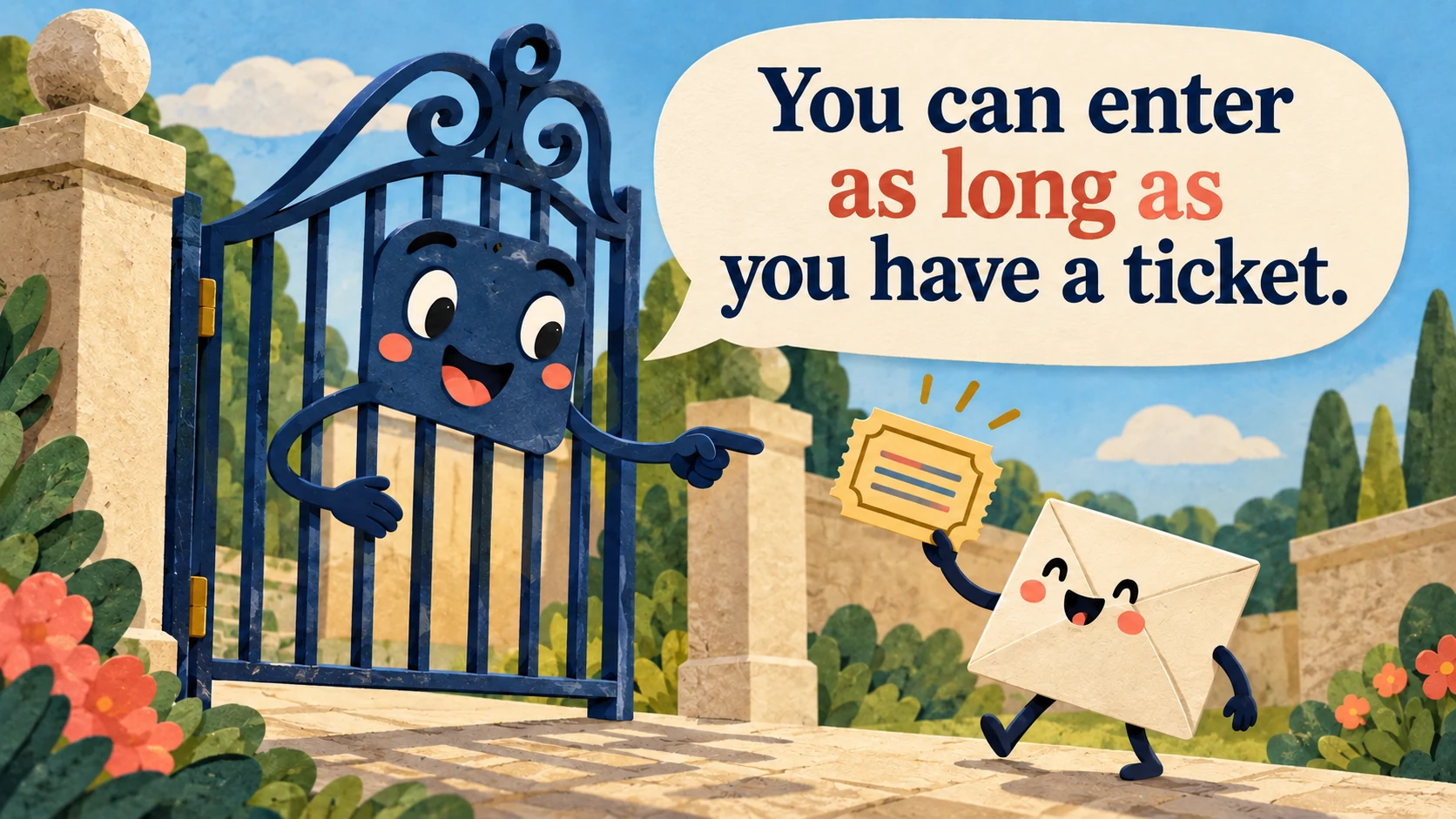
As long as means only if when it sets a condition: You can come as long as you bring a ticket.
Provided that has a similar meaning but sounds more formal: You may use the room provided that you leave it tidy.
Work out what happens without the condition
Imagine a venue that requires tickets. You can't enter unless you have a ticket means If you don't have a ticket, you can't enter.
| Ticket situation | What the rule tells us |
|---|---|
| You don't have a ticket. | Entry is not allowed. |
| You have a ticket. | This requirement is satisfied; other rules may still apply. |
Unless removes a negative from the ordinary if not condition. Unless you hurry, you'll be late matches If you don't hurry, you'll be late. Do not add don't after unless when you mean that same warning: it would reverse the condition.
This does not mean negatives can never follow unless. I'll come unless you don't want me there has a different, meaningful condition. At B1, first make sure the simpler unless = if not paraphrase gives the intended message.
A condition on permission
You can borrow my bike as long as you return it tonight gives permission with a requirement. Provided that expresses a similar condition in a more formal way: The booking can be changed provided that you contact us in advance.
The speaker is not merely predicting the result; they are setting a condition. That is why these expressions are useful in offers, agreements and notices.
Choose the meaning
| What you mean | Natural sentence |
|---|---|
| A result if something does not happen | Unless you practise, you won’t improve. |
| Permission with a condition | You can stay as long as you’re quiet. |
| A formal requirement | The refund is available provided that you have the receipt. |
As long as can also describe duration: I’ll stay as long as you need me. Context tells you whether it means a time period or a condition.
Tense in future conditions
Like an ordinary if-clause, a future condition normally uses a present form:
- Unless it rains, we’ll play outside.
- We’ll go ahead provided that everyone agrees.
The result clause can use will, can or an instruction, depending on the message.
Follow the same situation through three versions
If you bring your ID, you can collect the parcel.
You can't collect the parcel unless you bring your ID.
You can collect the parcel provided that you bring your ID.
All three make the ID important, but they frame the message differently: a possible condition, an exception to a negative result, or an explicit requirement. In real situations, other requirements may also apply; a conditional does not always list every rule.
For a future arrangement, keep a present form after the linker: I'll lend you the camera as long as you take care of it. The result is future, but as long as you will take care is not the normal form for this condition.
Condition or length of time?
You can stay as long as you keep quiet usually sets a condition. You can stay as long as you like usually refers to the length of the stay. The same words can have different functions.
Compare I'll help you if you need me with I'll stay as long as you need me. The first makes help depend on a need; the second describes the period for which the help continues.
The clause order is flexible: Unless the bus is late, we'll arrive by six; We'll arrive by six unless the bus is late. Put a comma after an opening condition, but normally not before a final one.
A useful editing method is to rewrite the condition with if. Unless it rains, we'll eat outside becomes If it doesn't rain, we'll eat outside. If your paraphrase says the opposite of your intended plan, change the original condition. Understanding the negative relationship is more reliable than memorising a translation.
Sources and further reading
Try this structure in a short practice set with instant feedback.
Start practice