Zero conditional
If I miss the last bus, I walk home. This is what normally happens in that situation, not a prediction about one particular evening.
Form and meaning
Use if + present simple, present simple to describe a general result, repeated habit or rule:
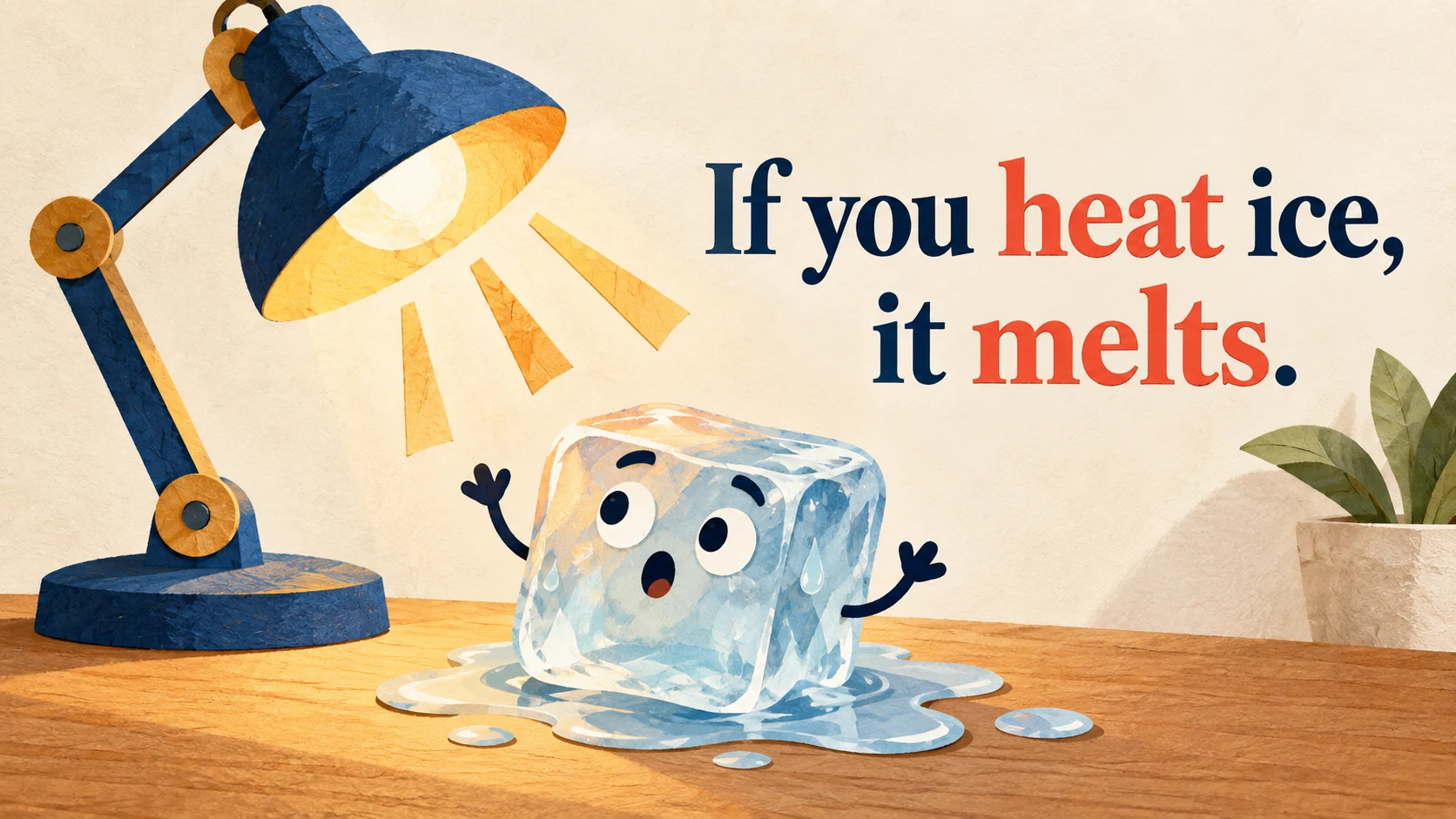
- If you heat ice, it melts. (general result)
- If I work late, I take the train home. (my usual routine)
- If the alarm sounds, everyone leaves the building. (rule)
The if-clause gives the condition. The other clause gives the usual result. You can reverse the order: Everyone leaves the building if the alarm sounds. Use a comma when the if-clause comes first.
Read the two clauses as condition and usual result
A clause is a group of words built around a verb, usually with a subject. In If I skip breakfast, I feel hungry by ten, there are two:
| Clause | Job |
|---|---|
| If I skip breakfast | The situation we are considering |
| I feel hungry by ten | The usual result for me |
The sentence does not say you skip breakfast every day. It says that on the occasions when you skip it, this is the result.
You can picture the meaning as a repeated connection:
Skip breakfast → feel hungry
The same connection applies on different mornings.
This pattern is useful for explaining personal routines, simple processes and familiar rules: If the battery is low, the screen shows a warning.
Build the present forms accurately
A third-person singular subject needs -s: If the machine stops, the light flashes. The two subjects may be different, so check each verb separately.
For ordinary negatives, use don't/doesn't + base verb: If he doesn't sleep enough, he feels tired. With be, use am/is/are: If I'm late, my tutor is worried.
Do not add will automatically because you see if. If I have free time, I read describes a usual response; If I have free time tomorrow, I'll read predicts a particular future response.
Zero or first conditional?
Compare the time frame:
- If it rains, we eat inside. This is our usual arrangement.
- If it rains tomorrow, we’ll eat inside. This is a possible result tomorrow.
The zero conditional is about what generally happens; the first conditional is about a possible future event.
Sometimes when can replace if when the event is expected to happen: When I get home, I make tea. If leaves the condition open.
More than facts
A zero conditional can describe personal habits, not only scientific facts. If my phone battery gets low, I switch on power-saving mode describes my routine. The statement does not have to be true for everybody.
Explain a rule without pretending it is universal
If I drink coffee after dinner, I can't sleep describes your experience. It is not a claim that coffee has exactly the same effect on everyone.
A modal can appear in the result: If you have a library card, you can borrow books. The familiar present-present pattern is useful, but real conditional sentences can use other forms to express ability or permission.
For instructions, If the screen freezes, restart the app tells the listener what to do. The result is an imperative, not a present-simple statement about what always happens. It belongs to the same practical family of condition-and-response sentences.
If and when give different emphasis
If I work late, I take a taxi leaves working late as a possible occasion. When I work late, I take a taxi presents it as something that does occur. In repeated routines, both can be natural.
When I get home, I make tea describes a habit. When I get home tonight, I'll make tea describes a future occasion. The time context matters as well as the conjunction.
Compare two comments about a printer:
If the printer runs out of paper, it stops. — how the machine works
If the printer runs out of paper during the meeting, I'll refill it. — what I plan to do on that occasion
To write your own example, choose a real routine and describe the condition accurately. If I don't understand a word, I check it in a dictionary is clearer than memorising a scientific example without understanding the connection.
Finally, use a comma when the condition comes first: If I'm tired, I take a break. In I take a break if I'm tired, a comma is usually unnecessary. Reversing the clauses changes the order of information, not the cause-and-result relationship.
Sources and further reading
Try this structure in a short practice set with instant feedback.
Start practice