Present perfect or past simple?
“I’ve been to Rome” tells us about an experience. “I went to Rome last year” tells us when it happened. The time connection changes the tense.
The two questions
Use the present perfect (have/has + past participle) when the exact past time is not the point and the experience or result matters now.
- Have you ever tried sushi? (life experience)
- I’ve lost my keys. (I cannot find them now)
Use the past simple for an event placed in a finished past time.
- We tried sushi on Saturday.
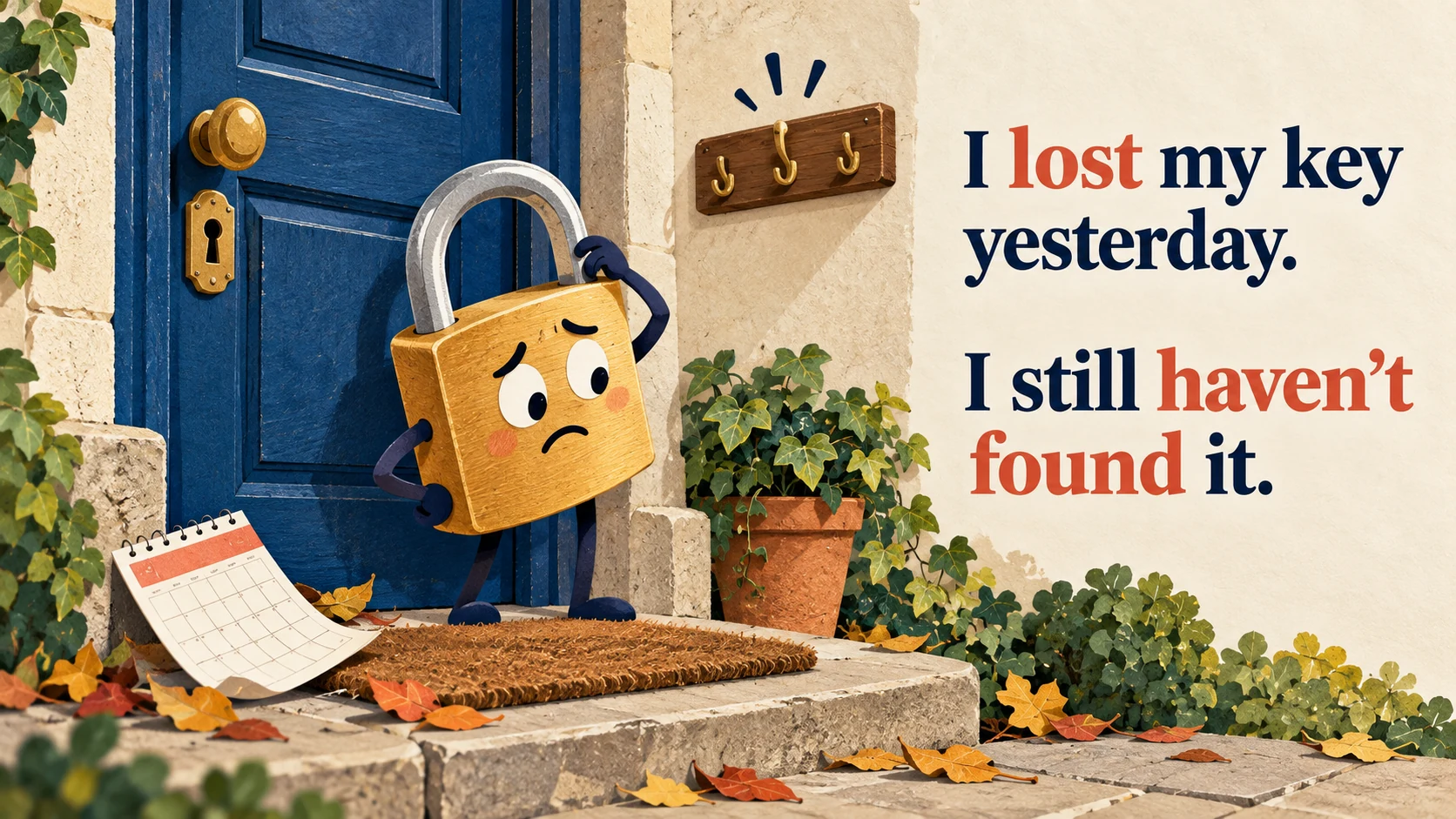
- I lost my keys yesterday.
The past simple sentence can still have a result now. The difference is that it places the event at a finished time.
Build both forms, then compare the viewpoint
| Purpose | Present perfect | Past simple |
|---|---|---|
| Statement | She has visited Rome. | She visited Rome in May. |
| Negative | She hasn't visited Rome. | She didn't visit Rome in May. |
| Question | Has she visited Rome? | Did she visit Rome in May? |
| Short answer | Yes, she has. | Yes, she did. |
For the present perfect, use have with I/you/we/they and has with he/she/it. The next verb is a participle: seen, gone, eaten, written. For regular verbs, the participle ends in -ed, just like the past form.
After did/didn't, use the base verb: Did you see it?, not Did you saw it?. Do not mix the constructions: Did you have seen it? should be Have you seen it?
A simple timeline can help:
Past simple: a finished past point — I met her on Tuesday.
Present perfect: a period or result connected to now — I've met her twice so far.
The present perfect does not mean the action itself is still happening. I've finished my homework describes a completed action. What connects it to now is the result: the homework is ready.
Look for the time frame
| Present perfect | Past simple |
|---|---|
| Have you seen that film? | Did you see it last night? |
| She has visited Paris twice. | She visited Paris in 2022. |
| I haven’t spoken to him today. (today is still in progress) | I didn’t speak to him yesterday. |
Words such as yesterday, last week, in 2022 and two days ago normally go with the past simple because they name a finished time. Ever and never often introduce life experience with the present perfect.
Follow a conversation
A: Have you ever travelled alone?
B: Yes, I have. I went to Lisbon last spring.
The first answer introduces an experience. The next sentence gives its specific past time, so it switches to the past simple.
An unfinished day can contain a finished event
At lunchtime, I've had two meetings today looks at the total so far. Later, I had a meeting at nine places one event at a specific finished time. Both sentences can be true on the same day.
Even today can appear with the past simple when you treat an opportunity as over: I didn't have breakfast today is natural in the afternoon. Time words are clues; the speaker's viewpoint still matters.
Been and gone give different information
Maya has been to the bank usually means she visited it and returned. Maya has gone to the bank normally means she is there or on her way, so she is not here now.
For experience, use been: Have you ever been to Edinburgh? After that general question, ask for past details: When did you go? What did you do there?
Just often signals a recent result: I've just sent the email. Already means earlier than expected or before now: She's already eaten. Yet often appears at the end of questions and negatives: Have you finished yet? I haven't finished yet.
In American English, the past simple is also common with recent events, just and already. I just sent it is therefore not automatically an error. The present perfect remains useful for connecting an experience, continuing period or result to now.
For a final choice, compare I lost my keys yesterday, and I still can't find them with I've lost my keys. Both can describe a current problem. The past simple is required by yesterday in the first sentence; the second presents the problem without locating the loss at a finished past time.
Sources and further reading
Try this structure in a short practice set with instant feedback.
Start practice