Present perfect with for and since
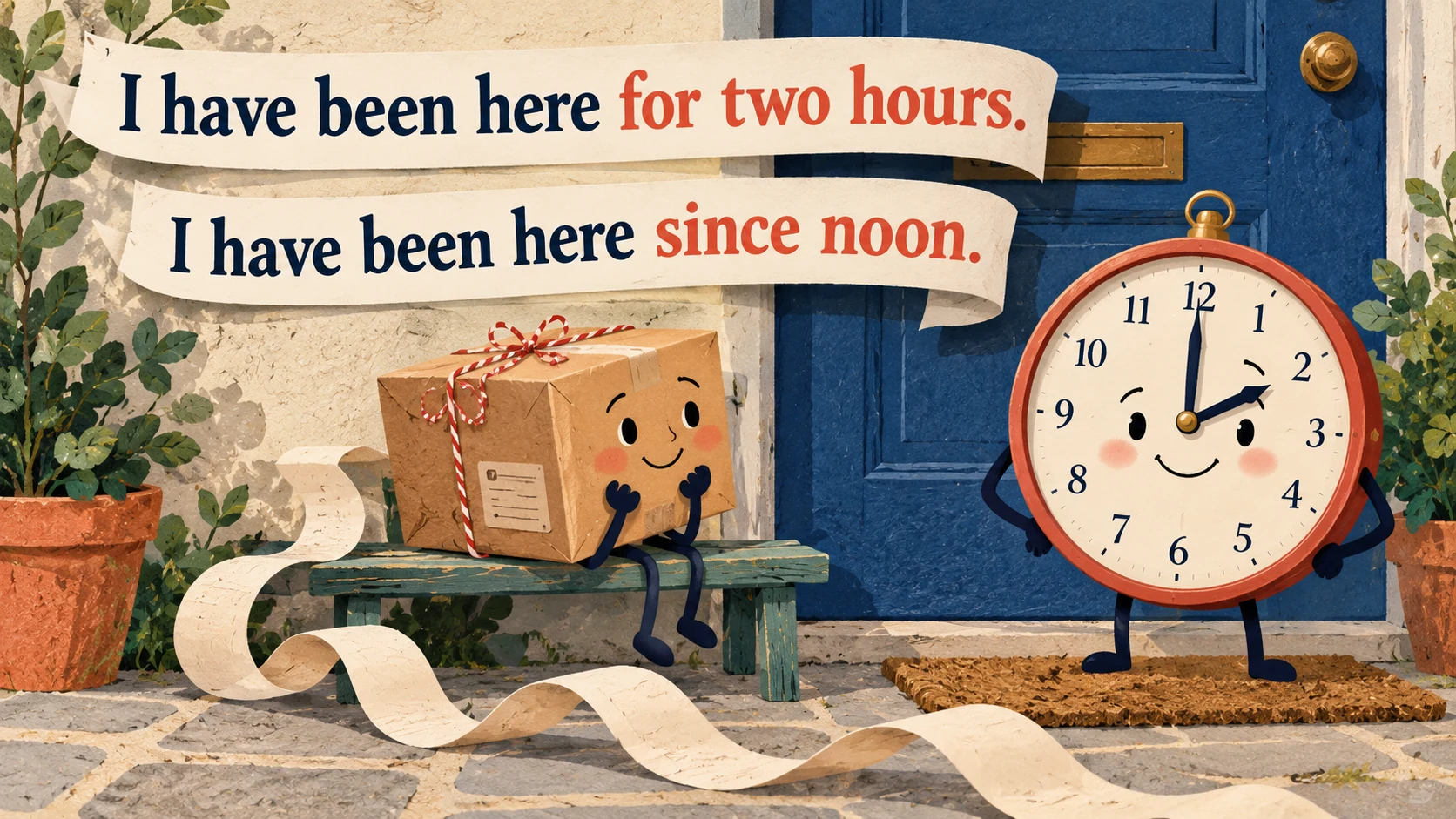
“I’ve lived here for three years” and “I’ve lived here since 2023” both describe a period that reaches the present. The words measure that period differently.
Duration or starting point?
Use for with a length of time: for two hours, for six months, for a long time.
Use since with the point when the period began: since Monday, since 2023, since I moved here.
- Nina has worked here for five years.
- Nina has worked here since 2021.
Both sentences tell us she still works here. The first answers How long? with a duration; the second answers Since when? with a starting point.
Draw the period before choosing the word
Imagine moving to a town in September 2023. In September 2026, you still live there:
September 2023 — move → three years living here → September 2026 — now
You can describe the same period in two ways:
I've lived here since September 2023. — name the beginning
I've lived here for three years. — measure the length
A date answers When did it begin? A duration answers How long has it lasted? That is the essential difference.
| Use for with a length | Use since with a beginning |
|---|---|
| for half an hour | since ten o'clock |
| for two weeks | since Monday |
| for several years | since 2023 |
| for a long time | since we first met |
Since I was a child gives the starting period. For my childhood does not express the same meaning and is not a natural replacement.
Ask the right question
How long have you known Eva? invites either answer: For six years or Since secondary school. You do not need to repeat the whole sentence in a short conversational reply.
Compare When did you meet Eva? This asks about the first meeting as a finished event, so the past simple is appropriate: We met in 2020. Knowing each other is the continuing state; meeting is the starting event.
Build the sentence
For an action or state that began in the past and continues now, use have/has + past participle:
subject + have/has + past participle + for/since + time
- We’ve known each other for years.
- He’s had this phone since January.
- How long have you lived in this town?
With since + clause, the starting event commonly uses the past simple: I’ve felt better since I changed my routine.
Compare with a finished period
- I’ve lived in Bristol for three years. I still live there.
- I lived in Bristol for three years. I am talking about a finished period; I may live somewhere else now.
The phrase for three years does not automatically require the present perfect. The time relationship decides the tense.
Duration can describe an activity or a state
I've worked here for a year and I've been working here for a year can both describe continuing work. The continuous version places more emphasis on the activity. With state verbs such as know and own, use the simple form: I've known her for a year, not I've been knowing her.
A negative can also describe a period up to now:
I haven't seen my cousin since January.
We haven't had a holiday for two years.
Here the period measures the absence of an event. It does not mean seeing or having a holiday has continued throughout that period.
The tense shows whether the period is finished
I worked at the café for six months describes a completed period of work. I've worked at the café for six months normally describes work continuing now. For works in both; it does not choose the tense.
You can also use for for a planned future duration: I'll stay for a week. Since in its time meaning looks backwards to a beginning, so it does not normally describe a future stay in that way.
A common first-language transfer is I live here since 2023. English usually needs the present perfect for this continuing period: I've lived here since 2023. Choose have/has, use the participle, then add the correct time phrase.
Try explaining a friendship in three connected sentences: We met at university in 2021. We've known each other since then. We've been friends for five years. The first gives the event; the next two describe the period reaching now.
Sources and further reading
Try this structure in a short practice set with instant feedback.
Start practice