Future continuous
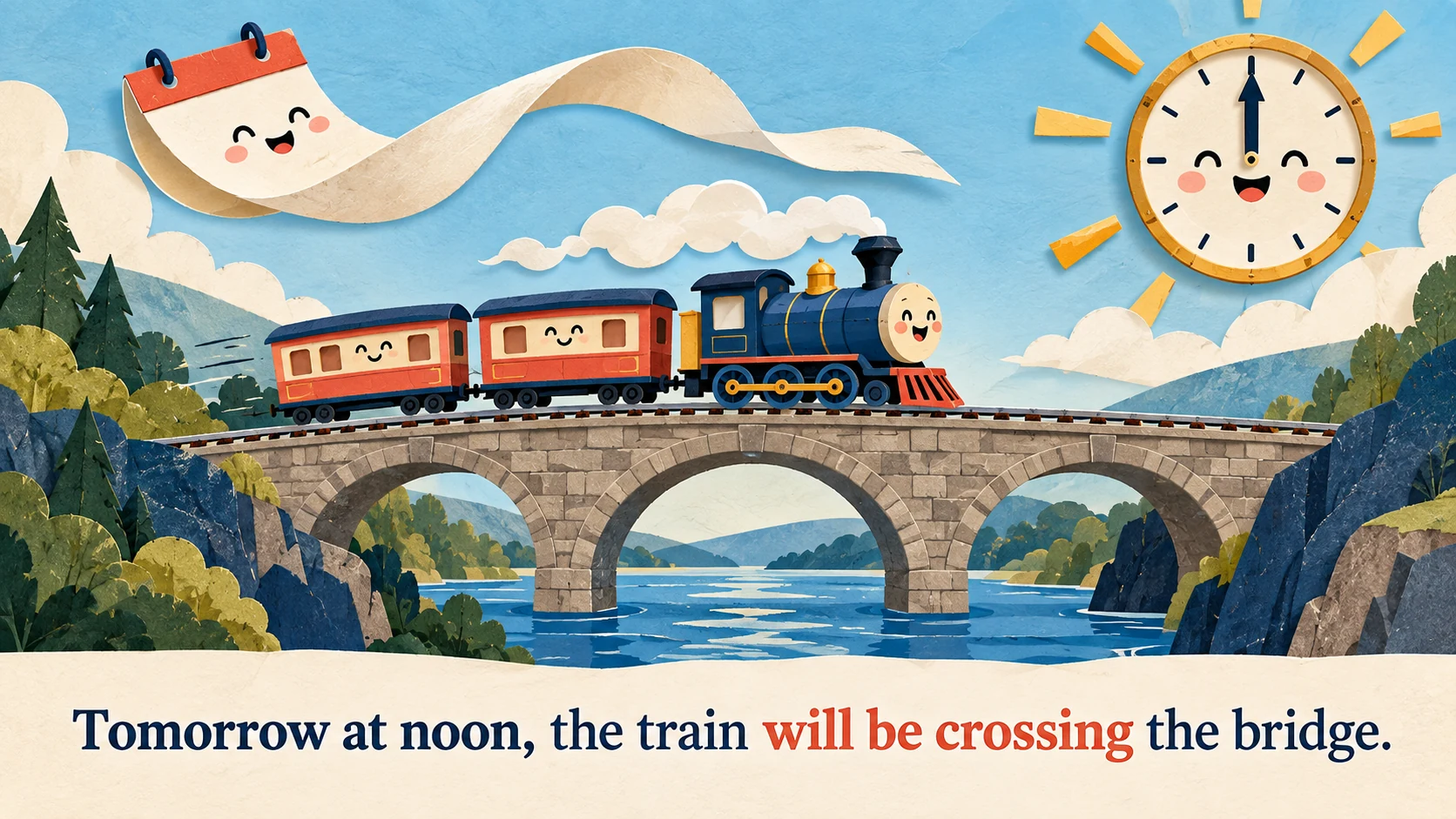
At this time tomorrow, you might be sitting on a train, giving a presentation or enjoying a day off. The future continuous lets you describe an activity that will be in progress at a particular future moment. Its form is will be + verb-ing:
At 9:00 tomorrow, I’ll be meeting the new team.
This time next week, we’ll be staying by the coast.
The time phrase creates a viewpoint in the future; the continuous form shows what will be happening around it. Like other continuous forms, it focuses on an activity rather than presenting it as a completed result.
A future event already in progress
When you arrive, we’ll be having dinner.
At midnight, the crew will still be repairing the bridge.
The dinner or repair will be underway at the future reference point. It may begin earlier and continue afterwards. This does not say exactly when the activity starts or finishes.
If you want to say that something will be complete before a future deadline, use future perfect instead: By the time you arrive, we’ll have finished dinner. Compare:
| What are you picturing? | Form |
|---|---|
| Activity in progress at 8:00 | At 8:00, I’ll be travelling home. |
| Completed before 8:00 | By 8:00, I’ll have reached home. |
Looking inside a future activity
Suppose your flight leaves at 10:00 and lands at 12:00. A friend asks whether they can call you at 11:00.
10:00 — flight starts → 11:00 — you are in the air → 12:00 — flight ends
Don't call at eleven. I'll be flying to Lisbon.
You are looking inside the future activity at 11:00. You are not saying the flight starts at eleven or is complete by eleven.
| Sentence | Viewpoint |
|---|---|
| I'll fly to Lisbon tomorrow. | The future journey as a whole |
| I'm flying to Lisbon tomorrow. | A current arrangement for tomorrow |
| At eleven tomorrow, I'll be flying to Lisbon. | The activity in progress at a future time |
| By one tomorrow, I'll have landed in Lisbon. | The landing completed before a future point |
The forms can overlap in real conversations. I'll be flying tomorrow may also describe an expected plan. The useful difference is the speaker's focus, rather than a rigid rule that only one form is possible.
Make statements, questions and negatives
Keep will + be + -ing together:
She will be staying with us.
She won't be staying with us.
Will she be staying with us?
The short answer is Yes, she will or No, she won't. Do not add does or change be to is: Will she is staying? is incorrect.
Common reference points include this time tomorrow, at eight tonight and when you arrive. In I'll be cooking when you arrive, the time clause uses arrive, although the arrival is in the future. After time conjunctions such as when and while, a present form normally expresses future time.
Predictions and polite questions
Future continuous can describe what you expect to be happening as part of the normal course of events:
The director will be speaking to the press after the meeting.
I expect most people will be using the new system by then.
It can also make a question about someone’s plans sound less direct. Will you be using the meeting room this afternoon? politely asks about an expected arrangement, while Will you use the meeting room? can sound more like a request or a decision the listener must make. Tone and context still matter; the tense does not make every question automatically polite.
A common mistake is to use will where the continuous is needed for an action already underway at the reference point: When you call, I’ll be driving, not usually I’ll drive if you mean that the drive will be in progress at that moment. But I’ll drive you home is correct when you are offering or deciding to do it.
It is not simply “a longer future”
The future continuous does not necessarily mean a long activity. The action can be brief if it is viewed in progress: At 10:15, the plane will be landing. Conversely, an event may take a long time but use another form if the speaker focuses on a plan or completion: We’re going to renovate the kitchen (intention); We’ll have renovated it by June (completion before a future point).
With when, after, before, as soon as and similar time clauses, English usually uses a present form for a future time: When the guests arrive, we’ll be eating, not when the guests will arrive. The main clause can still use future continuous.
Use this tense when a future time window matters to the message: arranging a call, explaining what you will be doing, or describing parallel events. If there is no future reference point and no reason to show an activity in progress, a simpler future form is usually more direct.
Cambridge’s entry on the future continuous compares it with future perfect.
Asking about plans without creating a request
Imagine needing a lift into town:
Will you drive into town tomorrow?
Will you be driving into town tomorrow?
The first can sound like a request to drive, depending on the context. The second more naturally asks whether driving is already part of the person's plans. You can then add: If so, could I come with you? The future continuous does not automatically make any sentence polite; it helps because you are enquiring about an expected activity.
A useful dialogue is:
A: Will you be using the meeting room at three?
B: No, we'll be working in the upstairs office.
A: Great. I'll book the room for my interview.
The first two lines describe expected arrangements. I'll book introduces a decision made in the conversation. The change of form reflects a change of purpose.
Finally, avoid continuous forms with ordinary state meanings: I'll know the result tomorrow, rather than usually I'll be knowing the result. With activity meanings, the continuous is natural: I'll be thinking about your proposal on the train. Ask whether the verb describes something unfolding, or a state such as knowing or owning.
Sources and further reading
Try this structure in a short practice set with instant feedback.
Start practice