So, such, too and enough
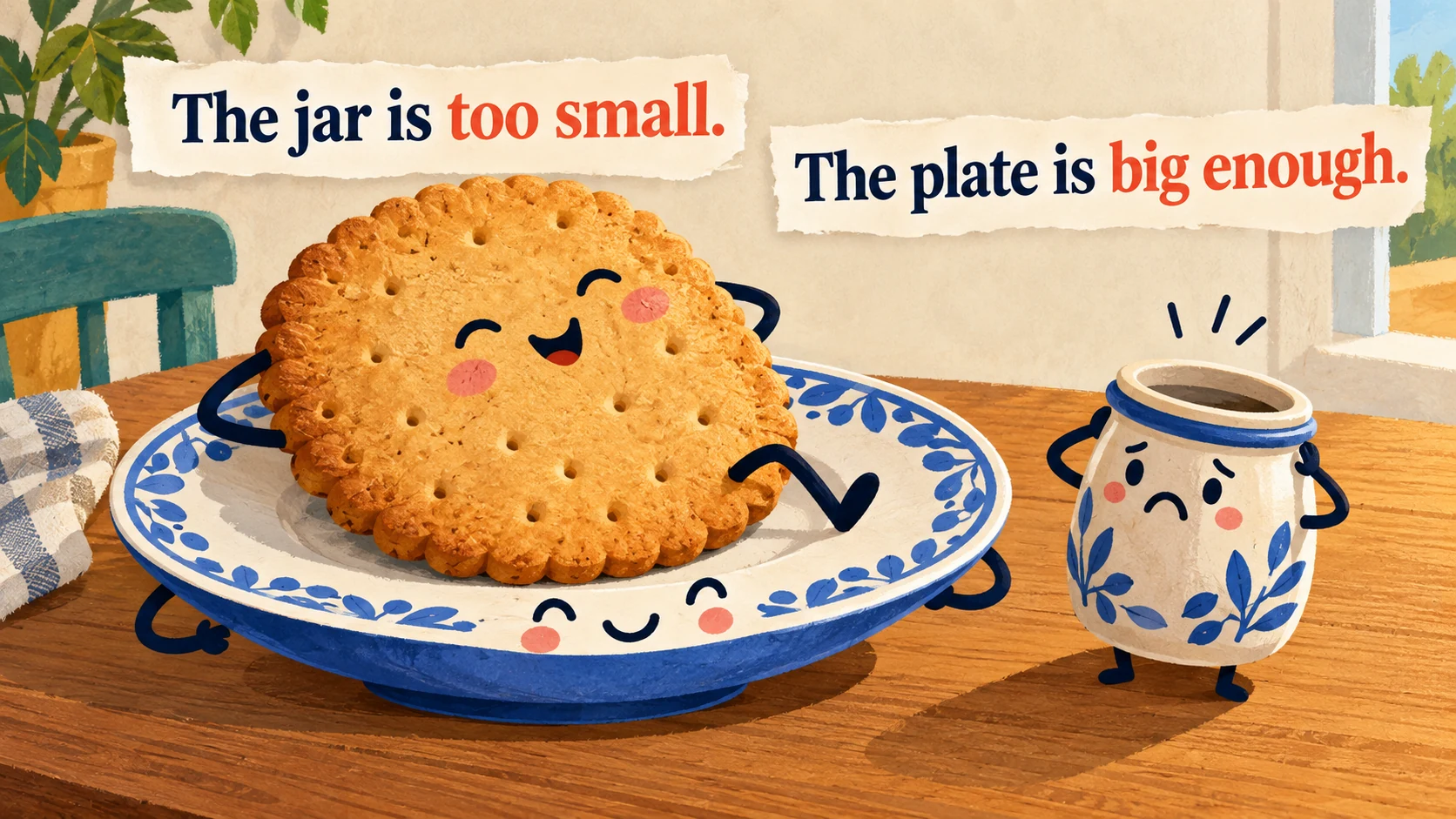
“The soup is so hot” describes its degree. “The soup is too hot to eat” says the heat causes a problem.
So and such: strong degree
Use so + adjective/adverb:
- The room was so quiet.
- She spoke so quickly that I missed the answer.
Use such + (a/an) + adjective + noun:
- It was such a quiet room.
- They are such helpful neighbours.
With a singular countable noun, include a/an: such a good idea, not such good idea.
Look for the noun before choosing so or such
The film was so funny contains an adjective, funny. It was such a funny film contains a noun phrase, a funny film.
| Following structure | Use | Example |
|---|---|---|
| Adjective | so | so helpful |
| Adverb | so | so carefully |
| Singular countable noun phrase | such a/an | such a helpful teacher |
| Plural noun phrase | such | such helpful teachers |
| Uncountable noun phrase | such | such useful advice |
The adjective can be the same, but adding a noun changes the construction. Do not write so a helpful teacher.
To show a result, add that + clause: The film was so funny that we watched it twice; It was such a funny film that we watched it twice. The result meaning is similar.
With quantities introduced by much/many, use so: There were so many people that we couldn't get in; There was so much traffic that we were late.
Strong degree is not automatically a problem
Your explanation is so clear! is positive. Your explanation is too complicated for me describes an unwanted excess. So emphasises degree; too normally says the degree goes beyond a useful limit in this meaning.
Too: more than is wanted or possible
Use too + adjective/adverb, often followed by to + verb:
- The box is too heavy for me to lift.
- He spoke too quickly for us to understand.
Too usually suggests a difficulty or unwanted excess. Compare The box is very heavy (description) with The box is too heavy to lift (consequence).
Enough: sufficient degree or quantity
Put enough after an adjective/adverb: The water is warm enough to swim in.
Put enough before a noun: We have enough time to finish.
The position changes with the word it modifies: old enough, but enough money.
Decide whether something meets the requirement
Imagine a shelf that needs to fit a large box:
The shelf is wide enough. — it meets the width requirement
The shelf isn't wide enough. — it falls short
The box is too wide for the shelf. — its width exceeds what fits
Enough is about sufficiency, not necessarily a large amount. We have enough money for two tickets could mean a small amount that exactly covers those tickets.
Too can also appear with quantities: too much noise, too many cars. Use much with uncountable nouns and many with countable plurals.
Add the person and the action
The bag is too heavy for me to carry identifies the person affected with for me. The bag is light enough for me to carry expresses the opposite practical result.
Do not repeat the object at the end: The bag is too heavy for me to carry it should normally be The bag is too heavy for me to carry.
Some verbs still need a preposition: The pool is warm enough to swim in. You swim in the pool, so in remains.
Notice the position of enough: quiet enough, slowly enough, but enough space, enough time. The quick question is “adjective/adverb or noun?”
Consider a café review:
The staff were so friendly, and it was such a comfortable place. The tables were large enough for our group, but the music was too loud for us to talk easily.
The first two phrases emphasise positive qualities. Enough shows that a requirement was met. Too explains a problem. Choosing the intended meaning before the word order makes these expressions easier to use.
Sources and further reading
Try this structure in a short practice set with instant feedback.
Start practice