Adjectives and prepositions
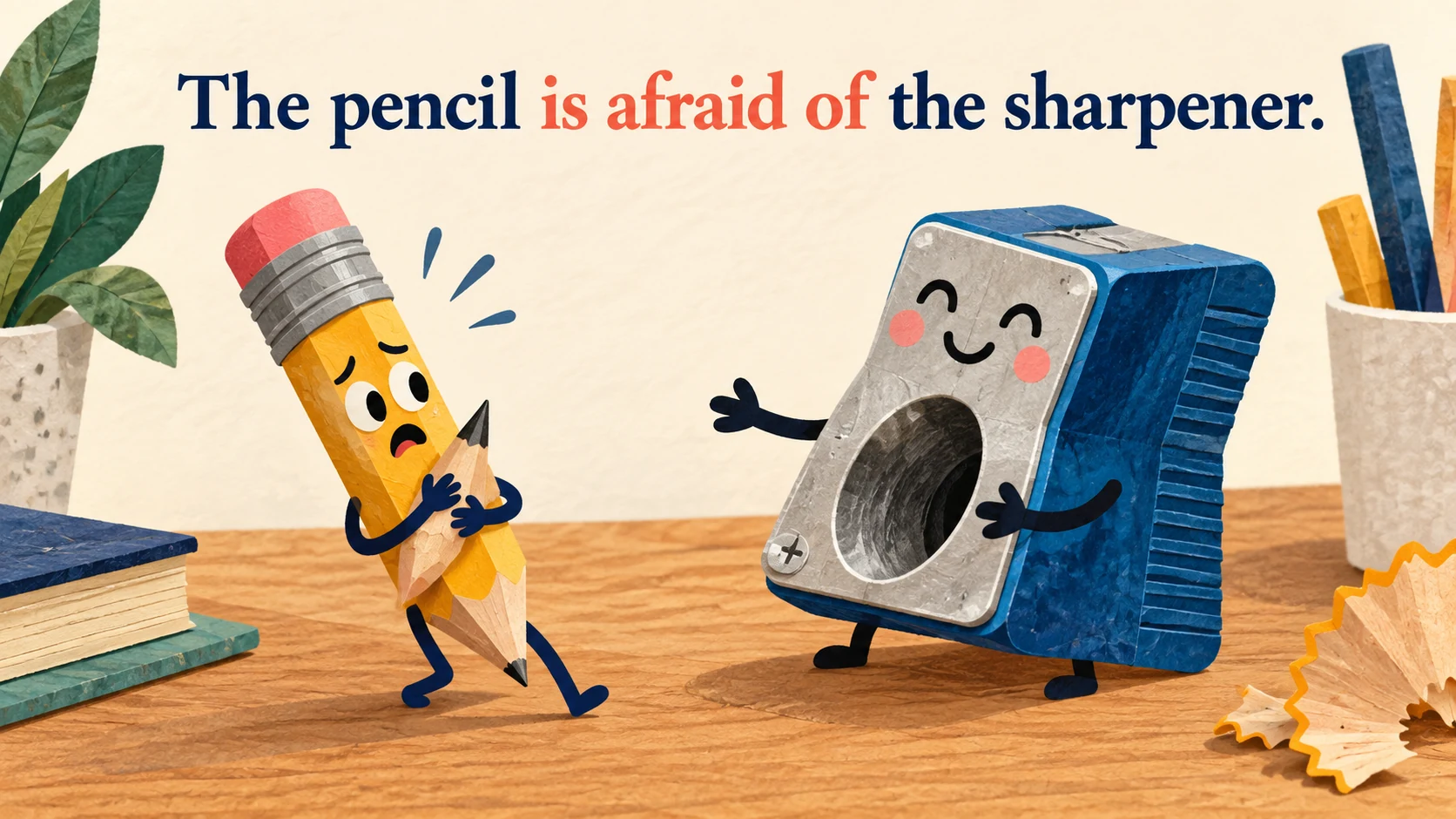
We say “interested in music”, “good at chess” and “afraid of spiders”. The preposition is part of the expression, so learn it with the adjective.
Useful combinations
| Adjective + preposition | Example |
|---|---|
| interested in | Mina is interested in photography. |
| good at | I’m good at remembering faces. |
| afraid of | He’s afraid of heights. |
| proud of | We’re proud of our team. |
| responsible for | She is responsible for bookings. |
| married to | Mina is married to Alex. |
These are common patterns, not a rule that lets you guess every preposition. A dictionary example can help you learn a new combination.
Learn the phrase as one useful unit
An adjective describes a person, thing or situation. A preposition connects it to another idea. In I'm proud of my daughter, proud describes my feeling and of my daughter tells you who the feeling concerns.
Different languages often make these connections differently. Learning interested alone will not tell you whether to use in, on or at. Learn interested in something as a unit.
| Useful phrase | What it connects | Everyday example |
|---|---|---|
| worried about | A concern | I'm worried about the exam. |
| pleased with | A satisfying result | She's pleased with her progress. |
| similar to | A comparison | This bag is similar to mine. |
| kind to | The person treated kindly | They were kind to us. |
| excited about | An exciting event or idea | We're excited about the trip. |
Notice that with and to can be correct in different phrases. Their position does not make them interchangeable.
An activity takes -ing after the preposition
Afraid of heights contains a noun. Afraid of falling contains an activity expressed with -ing. You can replace one with the other without changing of.
With a pronoun, use an object form: proud of her, kind to them, worried about us. Avoid proud of she.
Add a noun or an activity
A preposition can be followed by a noun: I’m interested in art. If the next idea is an activity, use the -ing form: I’m interested in painting.
- They’re excited about the trip.
- They’re excited about travelling together.
Do not put to + verb straight after these prepositions: good at to cook → good at cooking.
Notice changes of meaning
Some adjectives combine with more than one preposition, with a change in meaning:
- I’m angry with Sam. (the person)
- I’m angry about the delay. (the situation)
The words after the preposition show the relationship. Ask yourself what the adjective is connected to: a person, thing, reason or activity.
One adjective can describe different relationships
She's good at tennis describes skill. Exercise is good for your health describes a benefit. They've been good to me describes kind treatment.
These meanings are different, so the complete combination matters. Similarly, angry with Ali identifies a person, while angry about the cancellation identifies a situation. Angry at is also possible in several contexts; these common phrases are patterns to learn, not absolute divisions.
Do not assume two similar adjectives require the same preposition: interested in art, keen on art and enthusiastic about art are all natural.
A practical message with several patterns
I'm interested in joining your course. I'm quite good at reading, but I'm worried about speaking in front of other people. Would the beginner conversation group be suitable for me?
Interested in joining names the activity. Good at reading describes a skill. Worried about speaking names the concern. Suitable for me asks whether the group fits the learner.
Notice that both the preposition and the verb form need attention. Interested on join needs two repairs: interested in joining. Correcting only on would leave interested in join, which is still incorrect.
Some adjectives can also take a to-infinitive with a different construction: I'm happy to help. That does not make happy about helping or happy with the result interchangeable in every situation. The phrase expresses a particular relationship.
When reviewing vocabulary, write one sentence that matters to you: I'm responsible for feeding the cat, or I'm proud of finishing the project. Then practise replacing the complement with a noun, pronoun or another -ing activity while keeping the adjective and preposition together.
Sources and further reading
Try this structure in a short practice set with instant feedback.
Start practice